Guides
Behind the Work at SD Solar: Our Full Install Process
See how SD Solar handles solar installs from first call to grid connection, with real timelines, costs, and what to expect at each step.
By SD Solar5 min readUpdated 4 September 2026
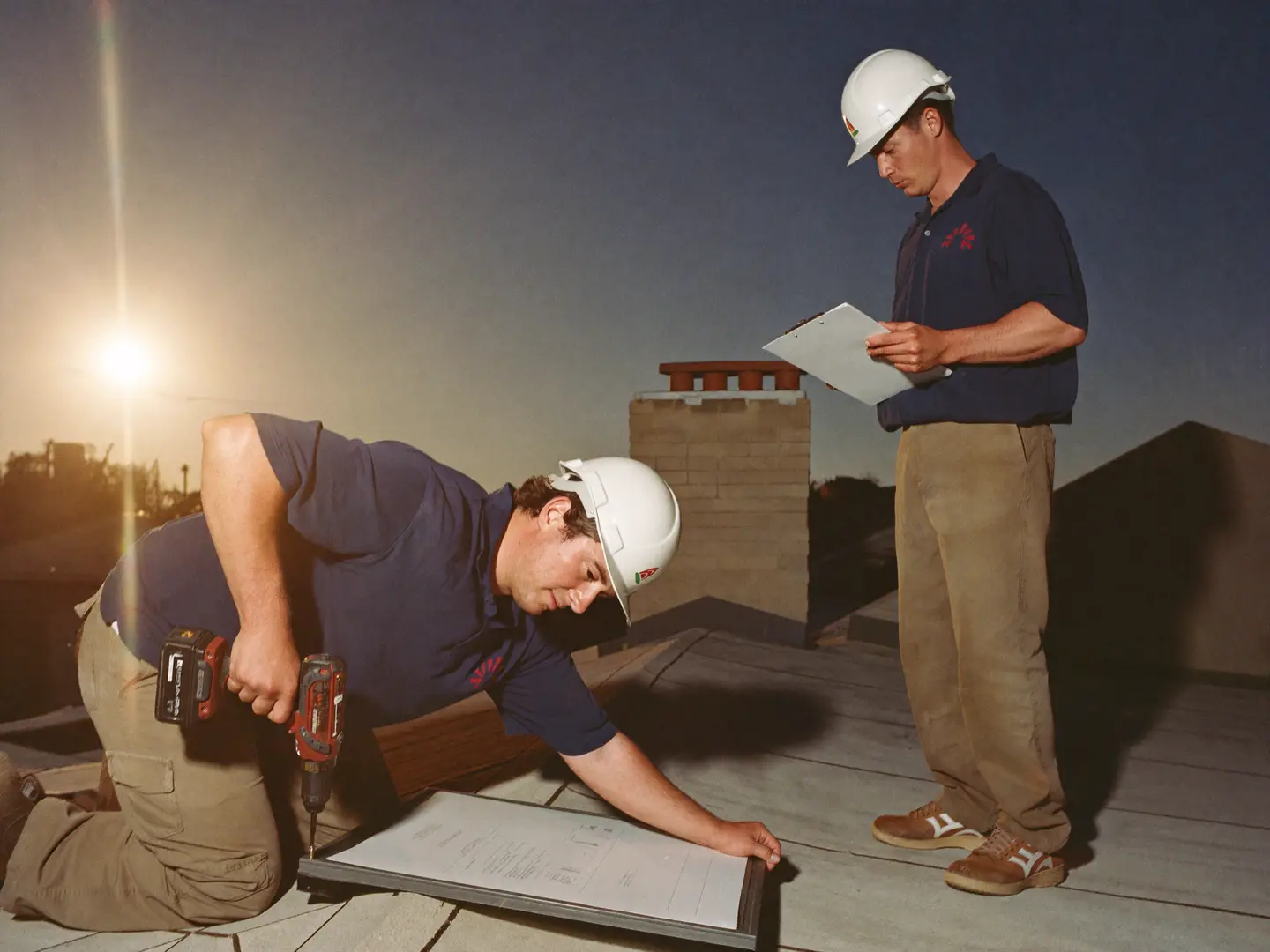
At SD Solar, our process runs from a free phone consultation through site survey, custom system design, permitting, panel and inverter installation, utility interconnection, and final commissioning. Most residential jobs take 6 to 12 weeks end-to-end, with the physical rooftop install completed in one to three days depending on system size and roof complexity.
What happens on the first call with SD Solar?
The first call is short. We ask about your average monthly electric bill, your roof age, shading, and whether you're looking at battery backup or grid-tied only. That gives us enough to send a rough production estimate the same day. Founded in 2018 and based on Cedar Avenue, we've done this intake thousands of times, and we've learned that a 15-minute conversation saves everyone a wasted site visit.
Most people ask first about price. That's the wrong first question. Ask about the failure rate of the inverter brand we install, because that single component drives roughly 80% of long-term service calls in residential solar according to industry field data [1].
If the numbers make sense on paper, we book a site survey. No pressure, no deposit yet.
How does the site survey and system design work?
A technician spends about 90 minutes on your property. We measure the roof, check rafter spacing, pull out the shade analyzer, and open your main service panel to confirm the busbar rating can handle backfeed under NEC 705.12 [2]. If your panel is a 100-amp with no room, we'll tell you before we design anything.
Back at the office, we build a design in 3-5 business days. You get:
- A shaded 3D model of your roof with every panel placed to scale.
- A year-one production estimate broken down month by month.
- A full equipment list with model numbers for panels, inverter, racking, and monitoring.
- A firm total price, itemized, with the federal tax credit shown separately.
- A financing comparison if you want it, including cash, loan, and lease side-by-side.
- A written 25-year production warranty and 10-year workmanship warranty.
Last March, a homeowner named Diego on Palm Street asked us to redesign three times before signing. Third version was the one. That's fine. We'd rather redraw than install something you'll resent in year two.
What's the timeline from contract signing to switch-on?
Here's the honest breakdown. Nothing skipped, nothing sugarcoated. You can also read our guide to choosing a solar partner before you commit.
| Stage | Typical duration | Who handles it |
|---|---|---|
| Permitting and HOA approval | 2-5 weeks | Our office |
| Equipment procurement | 1-2 weeks | Our warehouse team |
| Rooftop installation | 1-3 days | Our install crew |
| Utility interconnection and PTO | 2-4 weeks | Utility, we file |
The bottleneck is almost never us. It's the utility. Permission to Operate, the final approval that lets you flip the switch, took an average of 21 days across our 2023 residential jobs. Some utilities move in a week. Others take six. We'll tell you which one you're dealing with before you sign.
Why do we insist on a post-install walkthrough?
Because a solar system you don't understand is a system you won't trust. On commissioning day, we walk you through the monitoring app on your phone, show you how to read production versus consumption, and demonstrate what happens if the grid goes down. Try this: pull up the app 30 days after install and compare actual output to the estimate we gave you. If it's off by more than 8%, call us. We'll come out.
We also register your equipment warranties with the manufacturers directly, because homeowners forget and then lose coverage in year 11. Small thing. Matters a lot. More on our workflow philosophy in this earlier post.
For federal tax credit documentation, we send you the IRS Form 5695 worksheet pre-filled with your system cost. The current 30% Residential Clean Energy Credit is documented at energy.gov [3].
FAQ
How much does a typical SD Solar installation cost?
Residential systems in our service area run roughly $2.80 to $3.40 per watt installed before the federal tax credit. A common 8 kW system lands between $22,400 and $27,200 gross, or around $15,700 to $19,000 after the 30% credit. Batteries add $10,000-$16,000 depending on capacity.
Do you handle the permits and utility paperwork?
Yes. We file the building permit, the electrical permit, the utility interconnection application, and the net metering agreement. You sign the utility documents. We do the rest. If your HOA requires architectural review, we'll prepare that packet too at no extra charge.
What happens if a panel fails after installation?
Panels carry a 25-year manufacturer warranty on production and a 12-year warranty on defects. Our workmanship warranty covers the install itself for 10 years. Call us, we diagnose remotely through the monitoring system first, and if it's a hardware issue we schedule a replacement usually within two weeks.
Can I add batteries later if I start with grid-tied only?
You can, but it costs more than doing it upfront. Retrofitting a battery requires a new hybrid inverter or an AC-coupled battery unit, plus additional labor. If there's any chance you'll want backup within five years, we'll design the initial system to be battery-ready.